
Big-Box Retail Roofing in Staten Island, NY
Big-box retail roofing in Staten Island, NY: wide-span inspections, fastener and seam repairs, restoration and replacement for large stores on Richmond Avenue.
A chalk circle around a fastener plate that has backed out a quarter inch is the line an inspector writes on a big-box roof, because on a wide mechanically attached sheet one raised plate flutters in every gust, and flutter is how a seam opens that was tight the day it was installed. The timing matters because a store the size of a warehouse has a roof the size of a field, and a defect that small repeats a few hundred times across it.
The roof is walked in a grid. Large stores are too wide to read from a corner, so we divide the roof into bays, number them and record every finding by bay.
Where the large stores sit
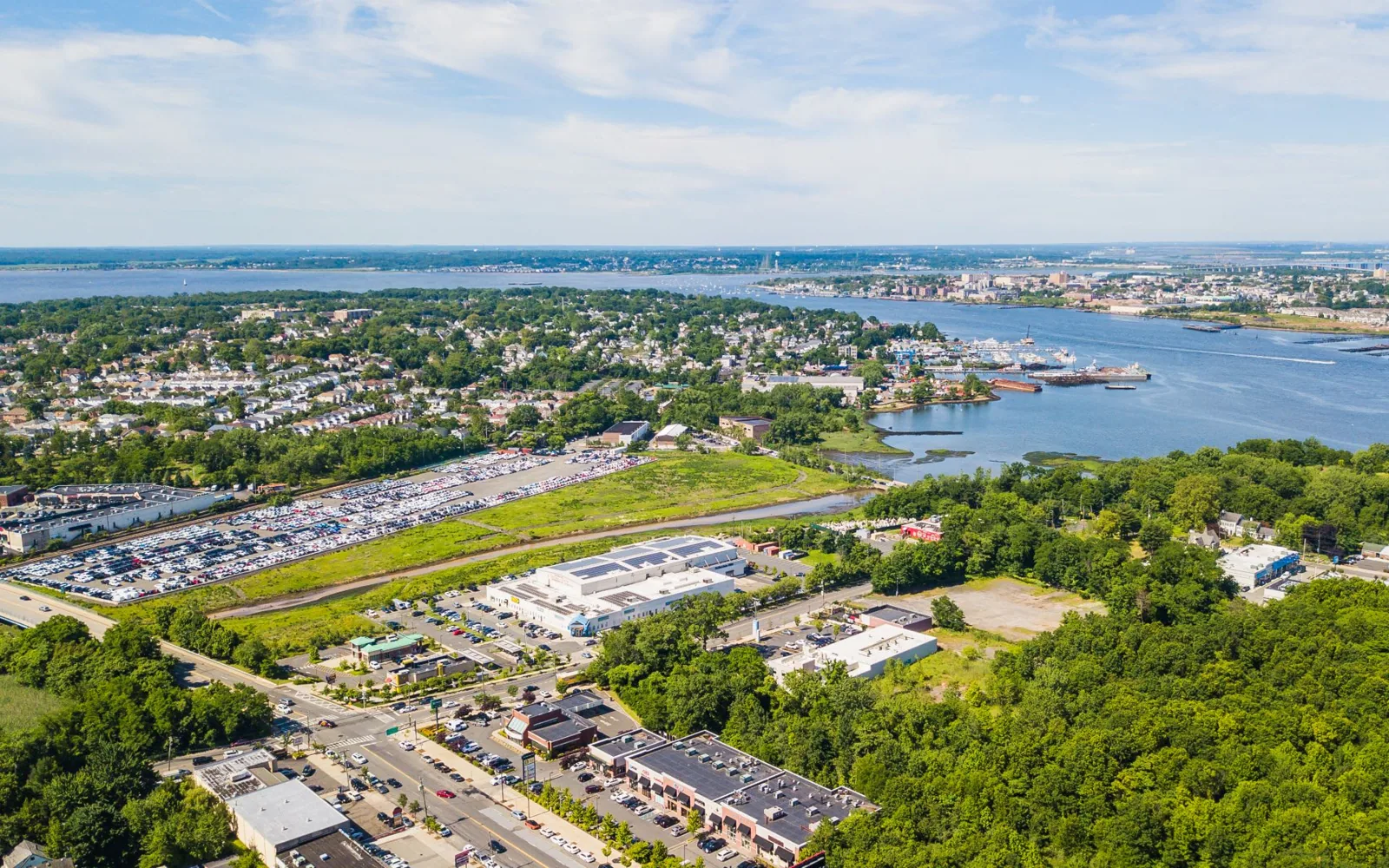
Large stores gather at a few addresses. Charleston's open-air Bricktown Centre, on Veterans Road West, has the island's first Target and its third Home Depot. The Staten Island Mall is the center of retail in New Springville, and Hylan Boulevard has had supermarket and department-store centers strung along it from New Dorp Lane since the 1960s. Richmond Avenue in Graniteville draws some of the heaviest automotive traffic on the island. Floor area describes a store, not the type of roof above it, so each building is opened and read on its own. What a large-format retail roof demands is consistent: long drainage runs, a shallow slope, many rooftop units and a surface that must stay dry above a sales floor full of stock.
Store formats differ. A garden center or lumber yard under a canopy has open edges and heavier drainage, while a warehouse-format store has a deep roof with few penetrations at the center and many at the perimeter. A grocery store roof carries the most refrigeration, and the survey adjusts to the format.
Fasteners, seams and flutter
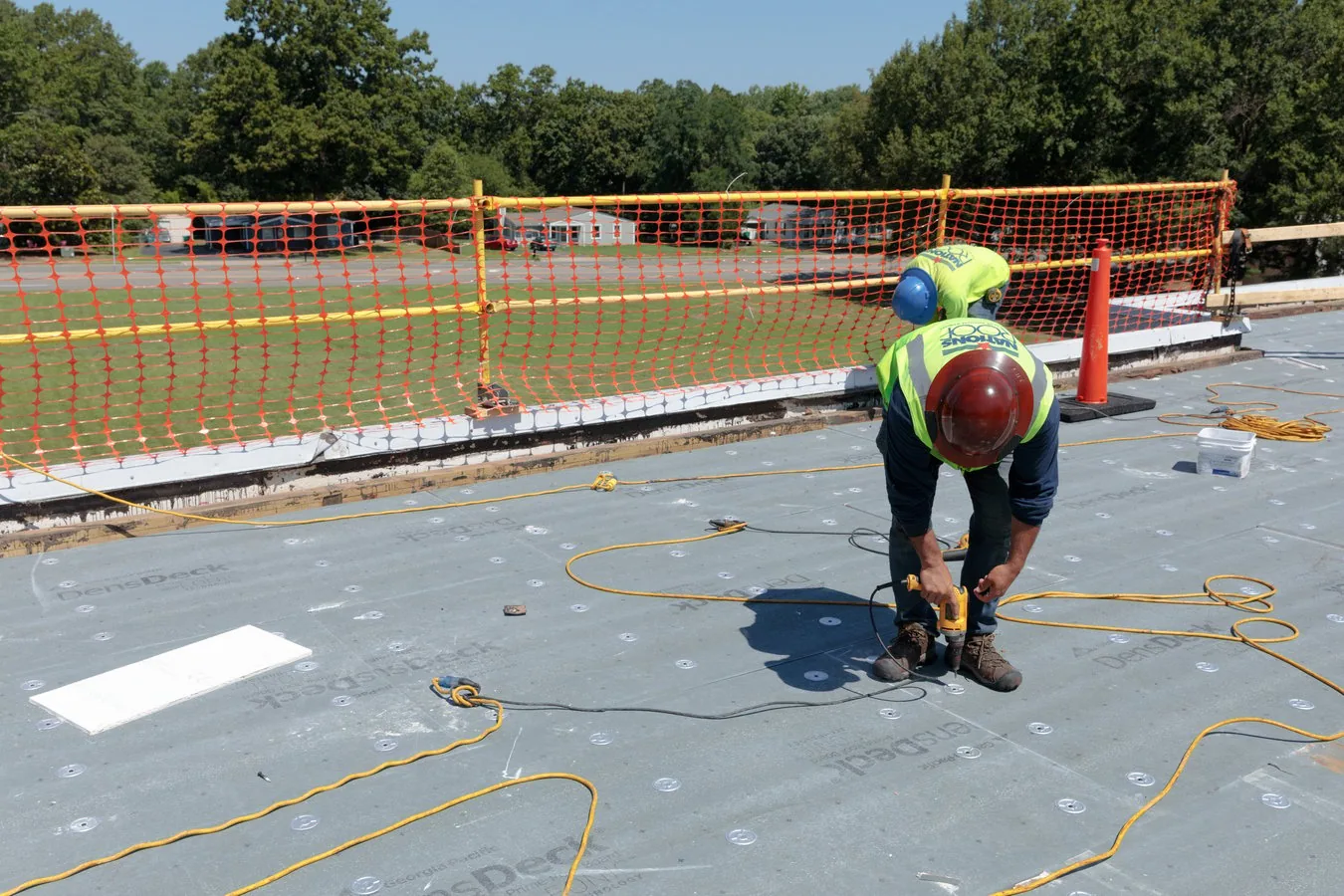
Mechanically attached single-ply systems are common on wide roofs because they are quick to install over a big area. They depend on fasteners holding the sheet down along the laps. When a fastener backs out, the sheet lifts there, and each gust works the lap. The sign is a faint ridge across the field, sometimes with a shiny line where the plate rubs the underside.
We scan for ridges, press down the high spots and count loose plates by bay. A roof with a handful of backed-out fasteners can be re-seated in a day. A roof with hundreds needs a plan, and sometimes a recover with a new attachment pattern. Seams are probed along their length, and open laps are marked and welded or taped.
Edges are the second place to look. Wind lifts a perimeter first, so we check the edge metal, the termination bar and the fasteners along the parapet. A row of fasteners at six-inch spacing holds a sheet that a row at twelve will not, and we compare what is installed against what the exposure calls for.
Long runs to a drain
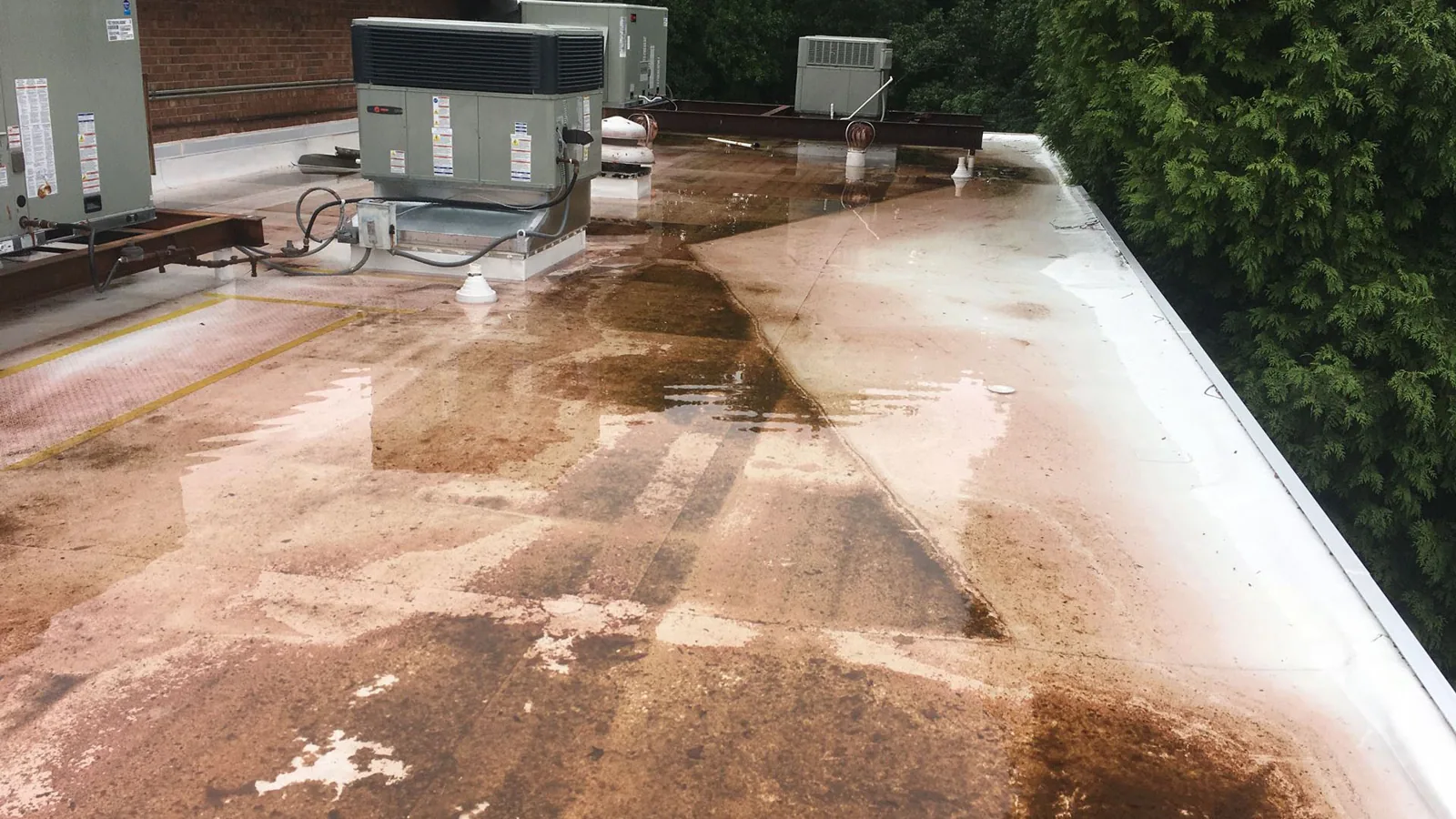
On a wide roof the farthest point may be a hundred feet from the nearest drain, so a small dip in the deck becomes a long shallow pond. We measure ponding depth with a straightedge along the line between two drains and mark the low zones on a sketch. Water sitting for more than a day or two leaves a ring of grit and stresses the nearest seam.
A ponding water repair may mean an added drain, tapered insulation under a new membrane or a recover that corrects the slope. Overflow scuppers are checked too, because a roof with only interior drains has no second exit when a strainer clogs in a cloudburst.
Insulation is the next question. Standing water that soaks in leaves a wet strip beneath the pond, and a moisture scan finds it. Dry insulation under a pond means the membrane is still doing its job; wet insulation under it means the roof has already begun to fail underneath.
Rooftop units and service traffic
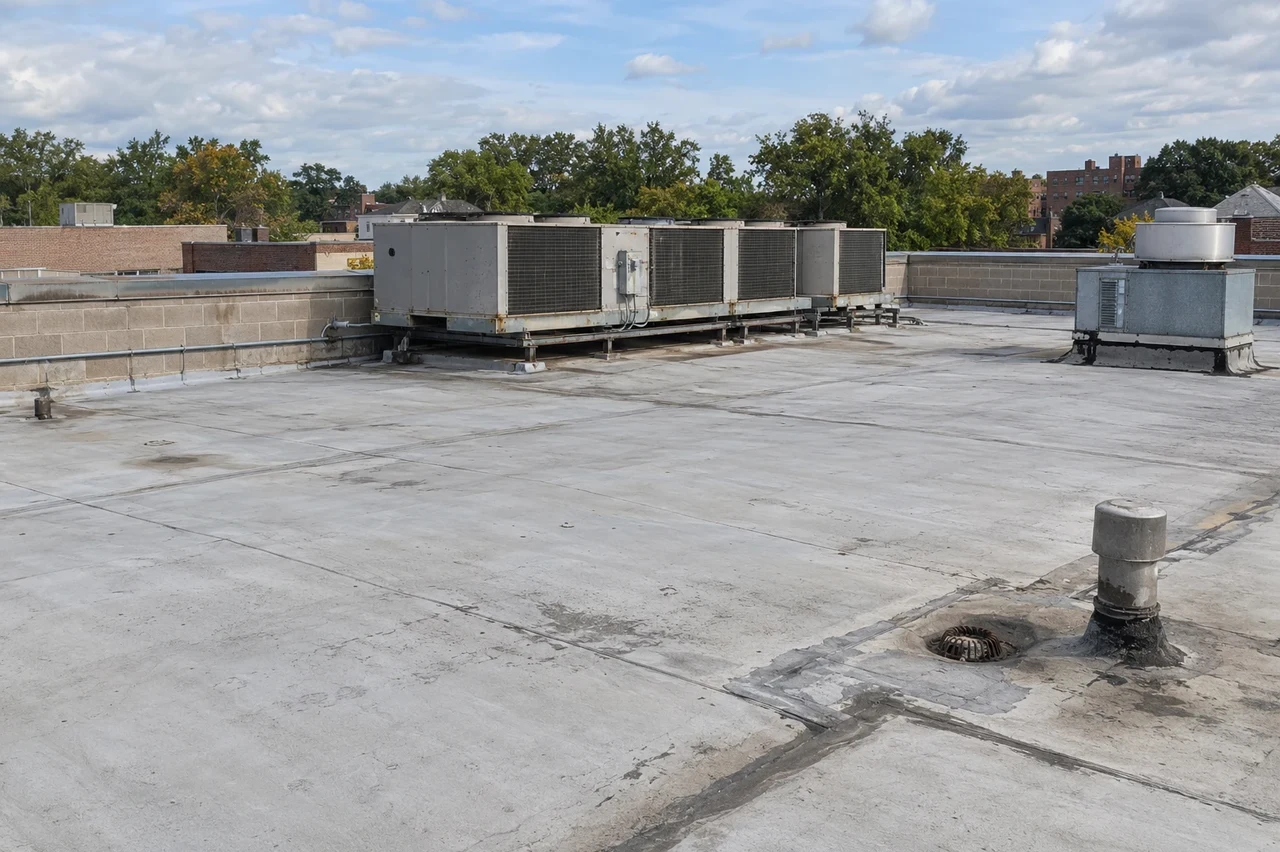
A big-box store carries refrigeration, air handling and exhaust on its roof, and technicians cross the sheet to service each unit. Walk-pad wear shows the routes. We install pads along them, check each curb and support and look for membrane thinning beside every unit.
Curb sealant is a small thing with a big effect. A split bead at the corner of a unit lets water into the insulation, where it spreads under the sheet. We reseal on schedule and log each curb. A curb and support review is a standard part of the walk.
Satellite dishes, security cameras and lighting poles are newer additions that people forget. Each bolts through the roof or sits on a ballast block, and each is a place where the original installer's warranty may have been altered. The log records every one.
Storm and winter checks
Wide, flat roofs are exposed to wind like the 80 mph gusts Sandy brought in October 2012, so after a major storm the perimeter fasteners, edge metal and parapet returns are checked first. A clogged drain on a wide roof puts a lot of water in one place in a short time, which is what Ida's September 2021 flash flood emergency demonstrated. The city's snow averages 29.8 inches a year and hit 27.3 inches on January 23, 2016. It covers drains and scuppers, and a thaw sends the water to the first open outlet.
Access and trading hours
A big-box store stays open, so we work in bays, close each at the end of a shift and keep customer paths and loading docks clear. Parking-lot space for a crane or lift is arranged with the store manager, with cones and signage. We avoid the holiday season and schedule noisy work for early hours.
Delivery times bend to bridge-day traffic on the Staten Island Expressway, which is among the city's busiest roads. Material arrives in small loads and moves to the roof the same morning.
Roof access is usually by a fixed ladder or an interior stair, and a store with neither needs a lift from the lot. We confirm the route during the survey, check the ladder cage and hatch for safety and note any fall-protection gaps for the owner.
What goes in the log
The log lists the bay grid, loose fasteners by bay, open seams, ponded zones, drains, curbs and the moisture map, and every entry has a photograph and a verdict on timing. A roof asset register keeps the record across years. Directors near Charleston and Graniteville get the same walk, and a smaller strip follows the pattern of a shopping center roof.
Related Roofing Work
More roofing work that comes up alongside Big-Box Retail Roofing.
Commercial Roofing Questions
Why does a wide roof flutter in wind?
The sheet is held at the laps by fasteners, and between rows it can lift. A loose plate makes it worse.
Can a big-box roof be coated?
If the membrane is sound and the insulation dry, yes. A scan and core cuts confirm it first.
How do you work without closing the store?
By bay, with customer paths protected, loading docks clear and each bay closed before the shift ends.
What is the first thing you check after a storm?
The perimeter and the drains. Wind and water both start there.
How long does a walk of a large roof take?
A day for most single stores, with a written log following in a few business days.
Should a lease require roof access approval?
Yes. A clause that requires the landlord's sign-off before rooftop work keeps new penetrations from being cut without flashing.