
Commercial Roofing in Linden, NJ
Commercial roof inspection, repair and replacement in Linden, NJ, along the Arthur Kill from Staten Island, for industrial and redevelopment roofs.
A discolored patch on a membrane, downwind of a stack and slick under a gloved thumb, is the first note on many industrial roofs in Linden, NJ, and it tells an inspector that the surface is dealing with more than weather. Commercial Roofing Staten Island inspects, repairs and replaces commercial roofs in the city, which faces Staten Island across the Arthur Kill, and each walk starts with the question of what the air and the equipment have done to the sheet.
Linden is an industrial city. It has a large refinery, a former automobile assembly site being redeveloped and a shoreline on the Arthur Kill that carries bulk cargo for the Port of New York and New Jersey. Roofs in a city like that face chemicals, heat, heavy traffic and tight rules for hot work, and each factor changes how a repair is chosen.
An industrial city across the Arthur Kill
Linden's Bayway Refinery, run by Phillips 66, turns out about 230,000 barrels a day, and the city's eastern boundary runs along the Arthur Kill, a channel that moves bulk cargo for the port. From 1937 until 2005 the city also had a General Motors assembly plant, and Duke Realty acquired its roughly 100 acres for redevelopment. We name these places because they describe the district: heavy industry, a working waterfront and land being turned to new use.
The roofs on any of them are a matter for a walk and a core cut. In general, roofs in a district like this need several things. Those are systems that tolerate chemical exposure, repairs made without open flame near process areas and drains that clear quickly under heavy rain.
What the inspector sees near process areas
The first entries are surface findings: staining, softening, glazing or chalking in a pattern that follows the wind. A membrane that has been exposed to oils, solvents or acid mist from an exhaust stack can lose plasticizer and stiffen, crack at seams or blister. We probe the affected area, compare it to a clean area and record both with photographs.
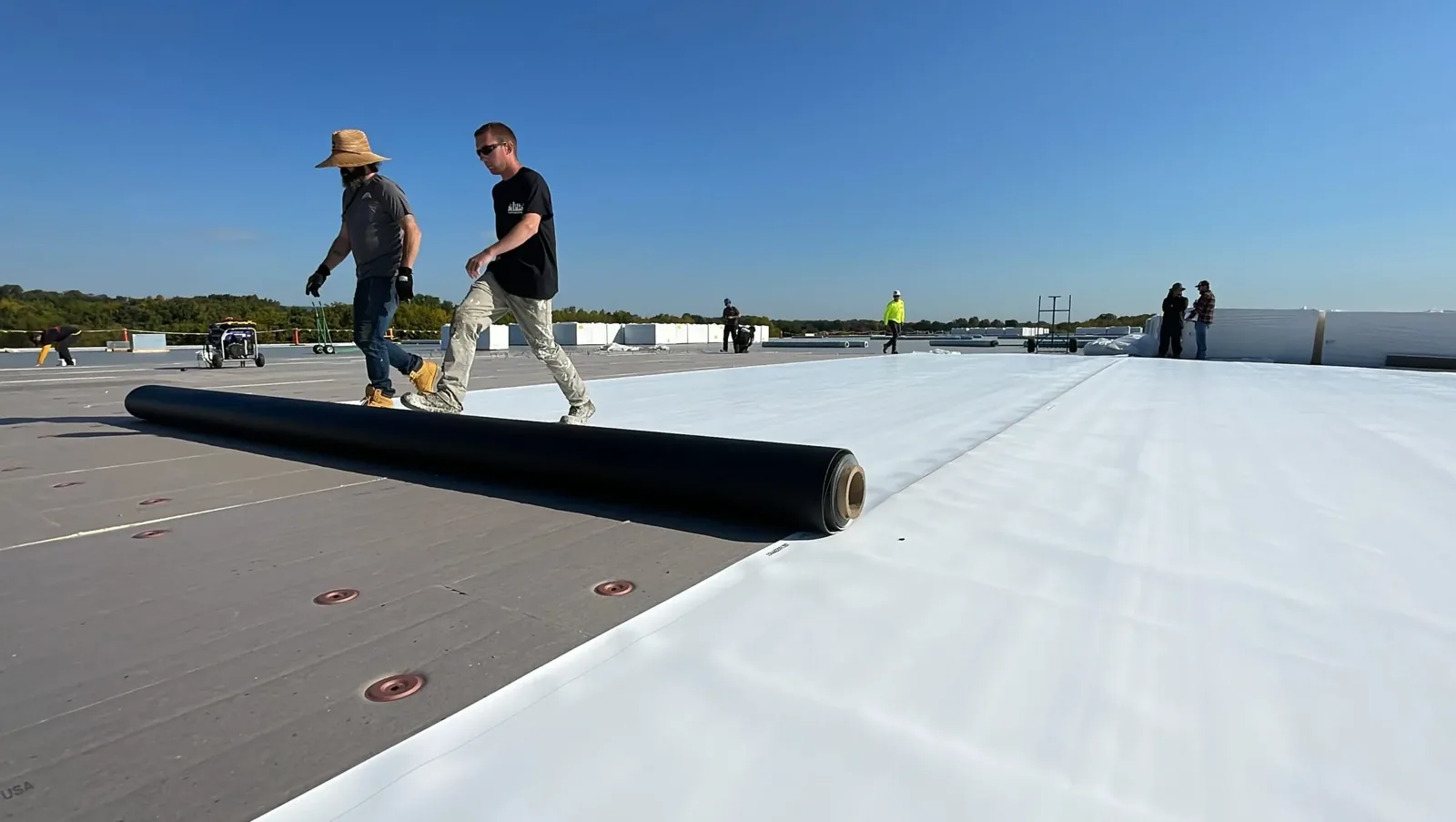
The second set of entries covers equipment. Process buildings carry large exhaust fans, makeup air units and pipe racks, and each is a penetration or a loaded spot. We check the flashing at every curb and the walk-pad wear along the service routes. The PVC roofing family is often considered for roofs that see grease and chemical exhaust, and we say in the proposal when another system suits the exposure better.
Walk-pad wear and drains close out the list. A service route that crosses the sheet from the stair to a fan wears a groove, and a groove is where the next puncture happens. Grit and fine process dust pack strainers quickly, so each strainer is cleared and photographed, and a note goes in the log on how fast it refilled. A drain that fills in a month needs a different cleaning schedule from one that fills in a season.
Ponded seams near drains are measured after rain. Standing water ages a membrane at that spot and loads the seams, and the cause, a settled deck or a blocked drain, decides the fix.
Hot work and permits
Open flame on a roof near process equipment or stored fuel is never a default. Owners usually require a hot-work permit, a fire watch and sometimes a shutdown of nearby equipment. If the rules or the risk make flame unwise, the work switches to self-adhered sheets, cold-applied adhesives, heat-welded thermoplastics or liquid-applied resins. Those methods are chosen and written into the proposal before the crew arrives.
Fire protection of the roof assembly is part of the same conversation. Insulation type, cover board and membrane all affect fire ratings, and the choice has to satisfy the owner's insurer. A fire damage roof repair starts from what a fire does to a membrane and its insulation, and the same knowledge guides the choices made before any fire.
Fire watch is only the start. After the last torch or heat gun is off, someone stays on the roof long enough to catch a smolder in a nailer or a wall cavity, and the crew leaves a log of times and readings. Owners near process areas often ask for that record, and it goes in the closeout file.
Redeveloped land and new roofs
When an old plant site is redeveloped, the new buildings that follow are measured against a clean baseline. The first inspection after completion sets down seam condition, drain function, edge attachment and the state of the curbs, and each later walk is compared with it. A new roof's early leaks tend to start at details, and a walk in the first year finds them while the repair is still cheap.
Large new buildings also carry long perimeters. Edge metal, coping and the first few feet of membrane inside it are checked for loose fasteners after any strong wind. The edge metal and coping work is quick when caught early.
Where an older roof stays on a site being redeveloped, the question is whether to keep it. A scan and a handful of cores answer it. If the insulation is dry and the deck is sound, a recover or a restoration may serve for years; if the board is wet, the roof comes off before the new tenant moves in. Deciding with facts costs far less than discovering the problem after the lease starts.
Weather on the Arthur Kill
Across the water the city gets roughly 29.8 inches of snow in a typical year, saw 27.3 inches fall in one day on January 23, 2016, and takes in about 49.5 inches of precipitation, most of it in a wet spring. Sandy's gusts reached 80 mph in October 2012, and Ida set off a flash flood emergency in September 2021. Together they make the seasonal list: strainers and overflows cleared before wet weather, seams probed after the thaw and perimeters checked after wind.
Repair, restore or replace
The scan and the cores decide. Damage confined to one spot is repaired with material that matches the roof. Coating restoration may suit a dry membrane worn only at the surface, while wet insulation across a wide area means replacement. Where chemical exposure is the cause, the proposal considers a different system, not the same one again.
Cost follows details, access and crane time. Hot-work restrictions, permits and shutdown windows are priced as their own lines so the owner sees them. Neighboring work in Carteret and Elizabeth is planned the same way.
What goes in the log
A roof plan with zones, photographs of every finding, scan results and a ranked repair list make up the log. Next to each item is a line giving the reason for its rank. It can go to an insurer, a lender or an operations manager without translation.
Related Roofing Work
More roofing work that comes up alongside Linden.
Commercial Roofing Questions
How do you tell chemical damage from ordinary weathering?
By the pattern. Weathering is even across the roof, and chemical damage follows the wind from a stack or a vent. We compare affected and clean areas and photograph both.
Can roof repairs be made near process equipment?
Yes, with permits, a fire watch and flame-free methods where the rules call for them. The plan is agreed with the operations manager before work starts.
What happens to a roof when a site is redeveloped?
New buildings get a baseline inspection, and any existing roof that stays is scanned and cored before an owner decides whether to keep it.
How far is Linden from the island, and does the distance matter?
It sits across the Arthur Kill, a short crossing by the Goethals Bridge, and crews and material travel that way. Deliveries are timed to avoid peak traffic, so distance rarely changes the plan.
Do chemical exposures change the repair material?
They can. A roof that sees exhaust or solvents may need a membrane that resists them, and the proposal names the choice and the reason.