
Commercial Roofing in Castleton Corners, Staten Island, NY
Commercial roof inspection, repair and replacement in the Castleton Corners district of Staten Island, NY, around the Victory Boulevard and Manor Road core.
A drain strainer left loose on a storefront roof near the crossing of Victory Boulevard and Manor Road is the kind of finding that grows in a retail district whose busiest days moved elsewhere. Castleton Corners, on Staten Island, NY, has long had its commercial heart at that intersection, and the commercial roofs around it are inspected, repaired and replaced by Commercial Roofing Staten Island, one walk at a time.
The district matured early. Most of the area was already built out when the Verrazzano-Narrows Bridge opened in 1964, so the roofs here carry the marks of the decades they have been through. Our first walk asks what the oldest layer is, what has been added to it and where water is getting past both.
The corner and the blocks around it
The meeting of Victory Boulevard and Manor Road forms the neighborhood's core and has been the center of an important commercial district for a long time. Retail activity there has declined somewhat since the Staten Island Mall opened in New Springville in 1973, and that history matters to a roofer for a practical reason: a block with fewer customers may have fewer people noticing a ceiling stain.
Each building on those blocks gets its own core cut before anyone names its roof type. Here is what we check on a retail roof in an older corridor. Vacant or lightly used units hide leaks, because nobody is inside to see the stain. Shared walls pass water from one roof section to the next. Tenants come and go, and each one leaves a vent, a sign bracket or a unit behind. All three are on the walk.
What the inspector writes first
On a low-slope storefront roof the first lines are about the edges and the drains: coping with an open joint, a parapet return lifted by a quarter inch, a scupper packed with leaves. Water moves from those spots into the wall, and the wall hides the damage until plaster or paint blisters inside.
The second set of lines covers whatever tenants added. A condenser fastened through the membrane, a hood fan on a curb with pulled flashing and a sign bracket bolted straight through the sheet each cost little to fix and a great deal to ignore. Our penetration flashing repairs replace sealant-only details with formed flashings set into a clean surface, so the weak point is removed rather than patched again.
Empty units and slow leaks
A slow leak above an empty unit does the most harm of any kind, since it can run for a whole season before anyone sees it. Insulation soaks, the deck begins to rot and the stain eventually appears in a neighbor's ceiling. We scan with infrared after sunset, when wet insulation holds heat and shows as warm patches, and confirm with a meter and a core cut. An infrared moisture survey across the whole building tells the owner how far the water has spread.
Owners of mixed buildings, part occupied and part not, can ask for the survey to map the vacant sections first. The result is a repair list ranked by what the water is doing to the structure, not by which tenant complained.
Once the wet area is mapped, the fix is local if the damage is local. Wet board comes out, new board goes in, and the membrane is tied back in with a proper lap. The mistake to avoid is coating over the wet section, which seals the moisture in and brings the blisters back within a season or two.
Repair, restore or replace
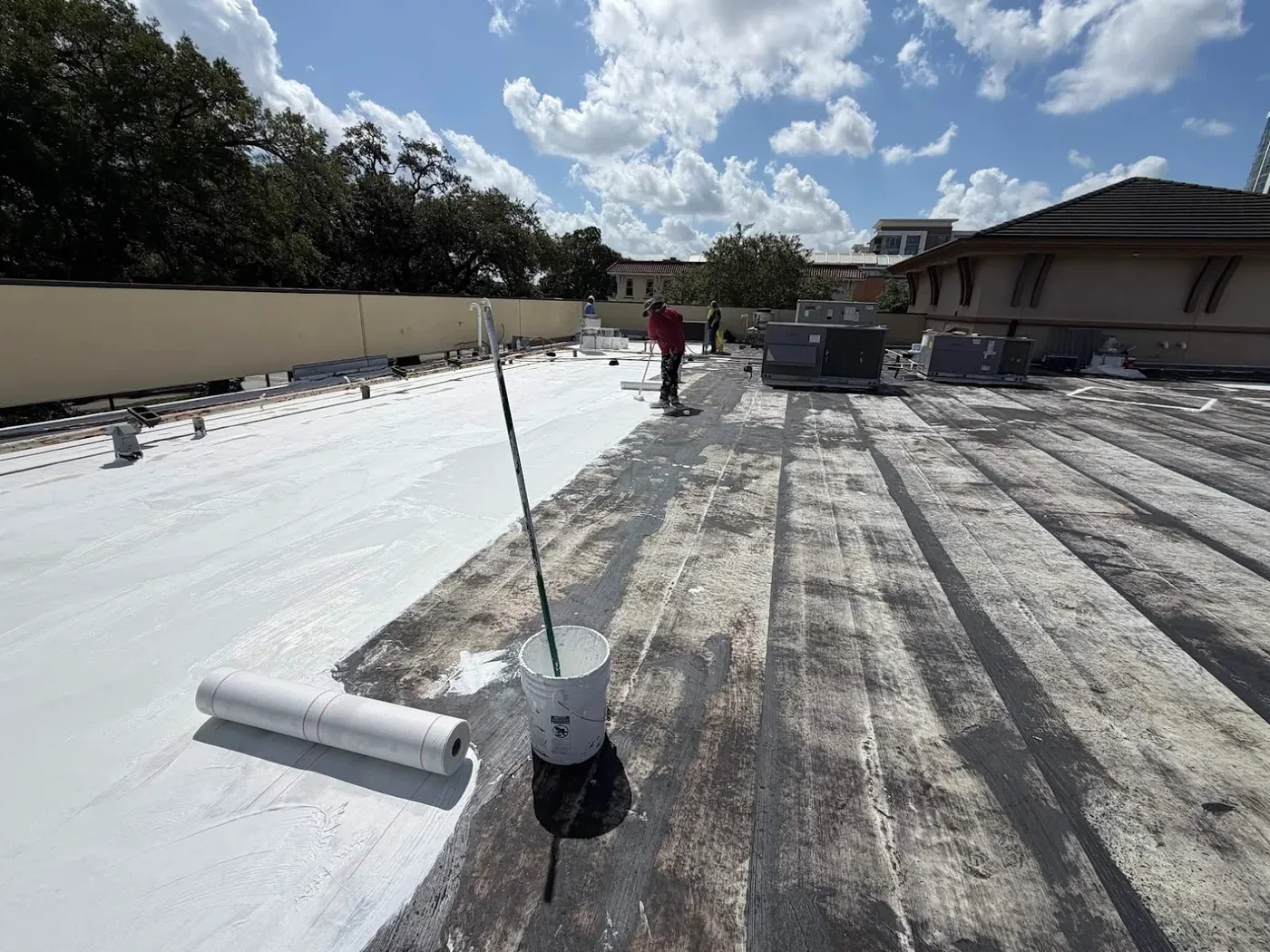
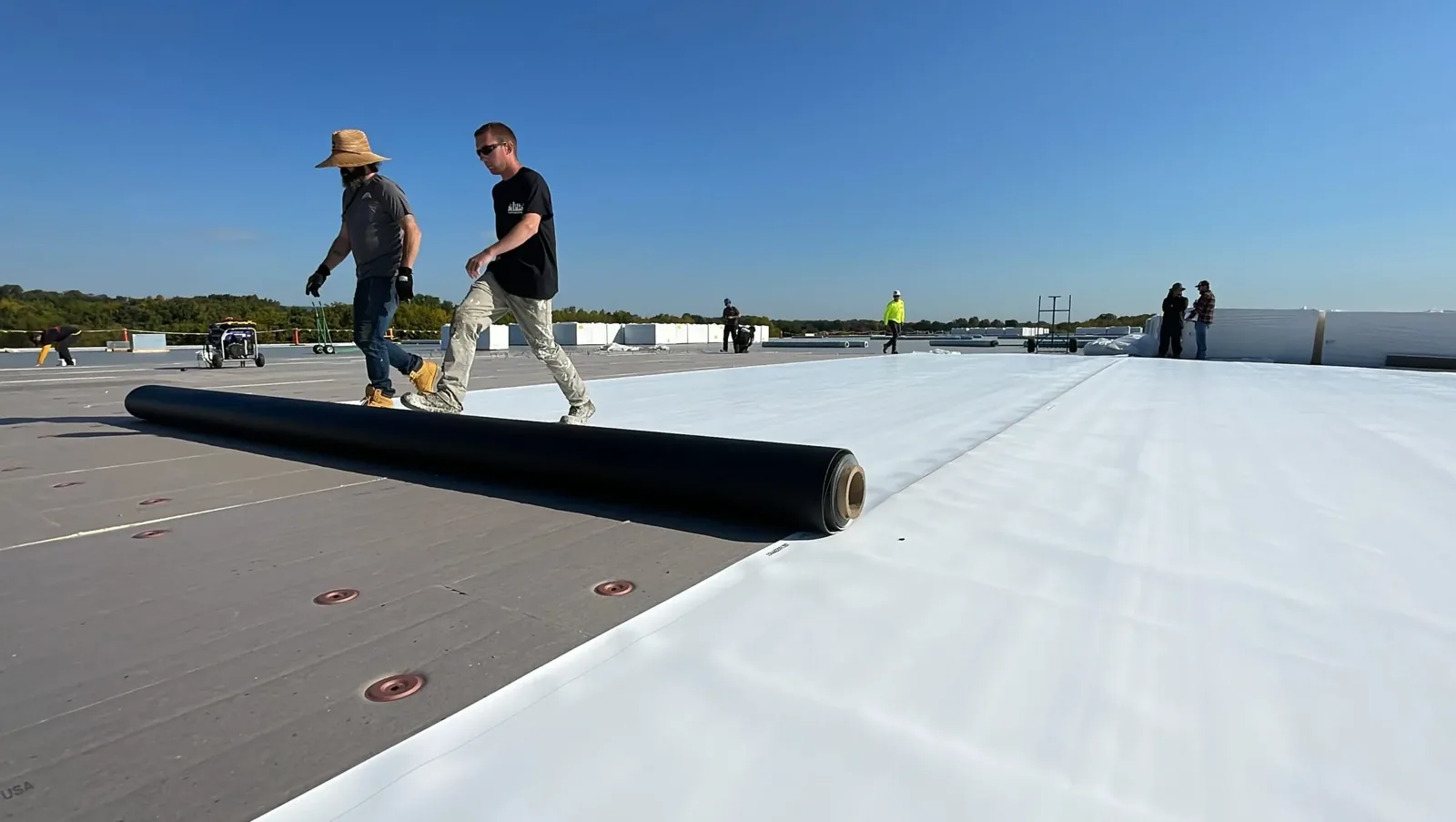
The choices follow the scan. A roof with one failed detail gets that detail rebuilt. A dry membrane worn at the surface can take a coating restoration, which spreads the cost over a longer life. A roof with wet board across much of its area needs a replacement, and when two or three layers already sit on the deck, the proposal prices a tear-off to the deck beside a recover so the owner sees the difference.
The details set the price: parapet length, penetration count, the state of the deck and the route a hoist takes to the roof. Small roofs on busy streets often cost more per square foot than large ones for exactly that reason, and we list those lines separately.
Phasing is common on small commercial blocks. The worst section goes first, tied cleanly into the old roof so that it sheds water on its own, and the rest is logged with a date for the next look. Even an owner who cannot fund the whole roof this year ends up with the leak stopped and a written plan for what remains.
Winter ice, spring rain
Snow in the city comes to about 29.8 inches in an average year, and the 27.3 inches of January 23, 2016 showed what a drift can do to a drain. Snow that melts and refreezes at a strainer turns a thaw into a pond overnight. We clear drains in the fall and again after the first real thaw, and we look at the first few feet of membrane inside each parapet for lifted laps.
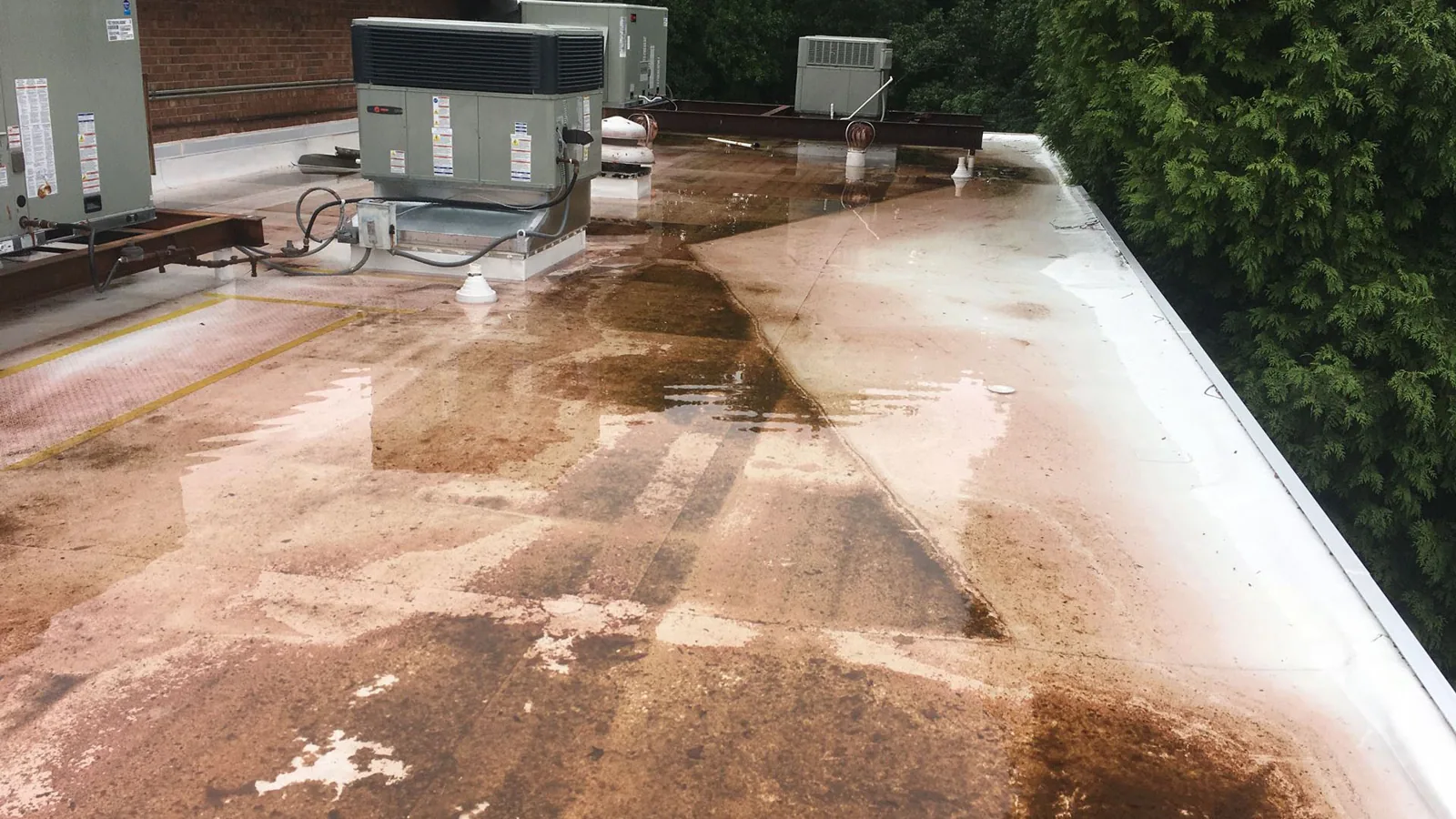
Spring is the wettest season, with the city averaging about 49.5 inches of precipitation a year. When Ida's rain brought a flash flood emergency in September 2021, an overflow scupper that was open and marked made the difference between a wet roof and a wet ceiling. Our ponding water repair work starts at the drain.
Sidewalks, tenants and trucks
Work above open storefronts is planned around the customers below. A hoist needs a sidewalk or a rear lot, a clear path to each door and a flagger when the lane narrows. Loud steps happen before opening or after closing, and tenants hear from us a day ahead. Material arrives early and sections are dried in the same day.
Other retail districts, New Springville and Graniteville among them, get the same sequence. A property owner with buildings in several of them can keep one inspection log format so the lists can be compared and the budget set once.
What lands in the log
The log holds the roof plan, a photograph of every finding, scan results and a ranked repair list, with a short reason beside each entry. An owner can pass it to a lender, a tenant or an insurer, and the next walk starts from it instead of from scratch.
Related Roofing Work
More roofing work that comes up alongside Castleton Corners.

Commercial Roofing Questions
How do you find a leak that started over an empty unit?
With a moisture scan after sunset and a core cut at each warm patch. The scan shows where the insulation is wet, and the cores show whether the water is new or old.
A shared wall is leaking into the next building. Who repairs the roof?
The lease and the deed settle that. We write down where the water enters and trace it across the party wall, so both owners see the same findings.
Does an older corridor need a different kind of roof inspection?
It needs a slower one. Older roofs carry more layers and more past repairs, so we core the roof to count them and probe every flashing.
Can one tenant's equipment be fixed without disturbing the rest of the roof?
Yes. The curb or penetration is cut out, reflashed and tested, and the neighboring membrane stays untouched. We log the work against that tenant's unit.
What is the quickest protection before a storm?
Clear the drains and the overflow scuppers, and secure loose coping. Those two steps stop most storm leaks before they start.