
Roofing for Public Agencies in Staten Island, NY
Roofing for public agencies in Staten Island, NY: bid-ready scopes, audit-ready roof logs, emergency documentation and phased capital plans.
A condition rating on a spreadsheet that has not been updated in three years, a bid tab with six prices that cannot be compared, an emergency leak at a depot that arrives between budget cycles: the first pages of a public agency's roof file are about records and rules. Commercial Roofing Staten Island works with cities, authorities, transit and park operators and other public agencies on the island, and we write reports and scopes to survive a budget hearing, a procurement review and an audit.
Public work is accountable work. The roof plan has to show its reasoning on every line.
A public portfolio of unlike buildings
A public agency's roofs range from civic landmarks to service buildings. Borough Hall, a French Renaissance building of 1906, sits on Richmond Terrace next to the Neoclassical courthouse of 1919. Elsewhere the public footprint includes the MTA's Charleston Depot on Arthur Kill Road, the Yukon Bus Depot with room for 380 buses, and Freshkills Park, about 2,200 acres rising on the landfill that closed on March 22, 2001.
The buildings vary as widely as the missions. A depot has wide roofs and heavy equipment, a courthouse has masonry and cornices, and a park building has small roofs in exposed settings. We rate each on its own terms and roll them up into an agency summary that a director can use in a budget meeting.
Procurement, bids and comparable scopes
Public bids reward clear scopes. We prepare documents with quantities, details, unit prices, alternates and performance requirements, written to the agency's format and reviewed with its procurement staff. Repair items, recover options and replacement options appear on separate lines so the agency can award what its budget allows.
Materials are described by type and performance unless the specification names a product, and warranty and wind-rating requirements are written in so every bidder prices the same roof. Wage and bid rules for public work are followed, and payroll reports or other filings are supplied when the contract requires them. Government building roofing scopes follow this format.
Records that survive an audit
Auditors ask what was done, when, by whom and at what cost. A dated roof log with photographs, scans, cores and repair records answers each question. We keep a file per building and update it after every visit, with before-and-after photographs of every repair.
The same file serves the agency's capital plan, insurance renewals and grant applications. When staff turn over, the file explains the roof to the next facilities director. Roof condition reports in a consistent format let an agency compare buildings across departments and set priorities that hold up in public.
What the first walk produces
Every roof gets the same sequence so ratings compare across buildings. The order is drains, since a clogged outlet skews every other finding; penetrations, curbs and rooftop equipment; the field, where soft spots get pressed and blisters, laps and splits get marked; and last the perimeter, the line at which flashing, coping and edge metal meet the wall. Next comes a moisture scan where leak history or age suggests wet insulation, and core cuts confirm it. A drone flight gives a quick overview of large roofs such as depot decks.
The output is a rating for each roof, a remaining-life range with reasons, a list of repairs with unit prices and a recommended action. A director who manages school buildings beside civic ones can read both in the same format, and a department that shares space with a health system can compare its roof with theirs. The summary page ranks the portfolio by risk, so the first dollars go to the roofs that put people or equipment in the path of water.
Emergency work and buildings that stay open
Public agencies can face a gap between a storm and an approved purchase order. A roof that fails in a storm cannot wait for a bid, and many agencies have an emergency procurement path. We keep documentation ready for that path: photographs of the failure, a written description of the hazard, a temporary-protection scope and a price.
Storms like Sandy, with its 80 mph gusts in October 2012, and Ida, with the city's first flash flood emergency in September 2021, are when a purchase order cannot be ready in time. Emergency roof repair in those conditions is documented the same day, so the agency has a record for reimbursement or an emergency declaration.
Courthouses, depots, libraries and service centers stay open during roof work. Security screening, restricted areas and public entrances shape how crews arrive. We submit crew lists early, follow badging rules and plan deliveries with building staff.
Work is done in sections, each closed in daily, with noisy steps kept away from hearing rooms, counters and public events. Where a facility runs shifts, the schedule follows them. Occupied building reroofing habits apply, with a named contact for every shift and a close-out walk with the facility manager.
Lifecycle cost, not the lowest price
A public roof is owned for decades, so the useful number is cost over its life. A cheaper membrane that needs replacement sooner can cost more over thirty years than a better system installed once. We show agencies the comparison: first cost, expected service life, maintenance needs and the cost of disruption.
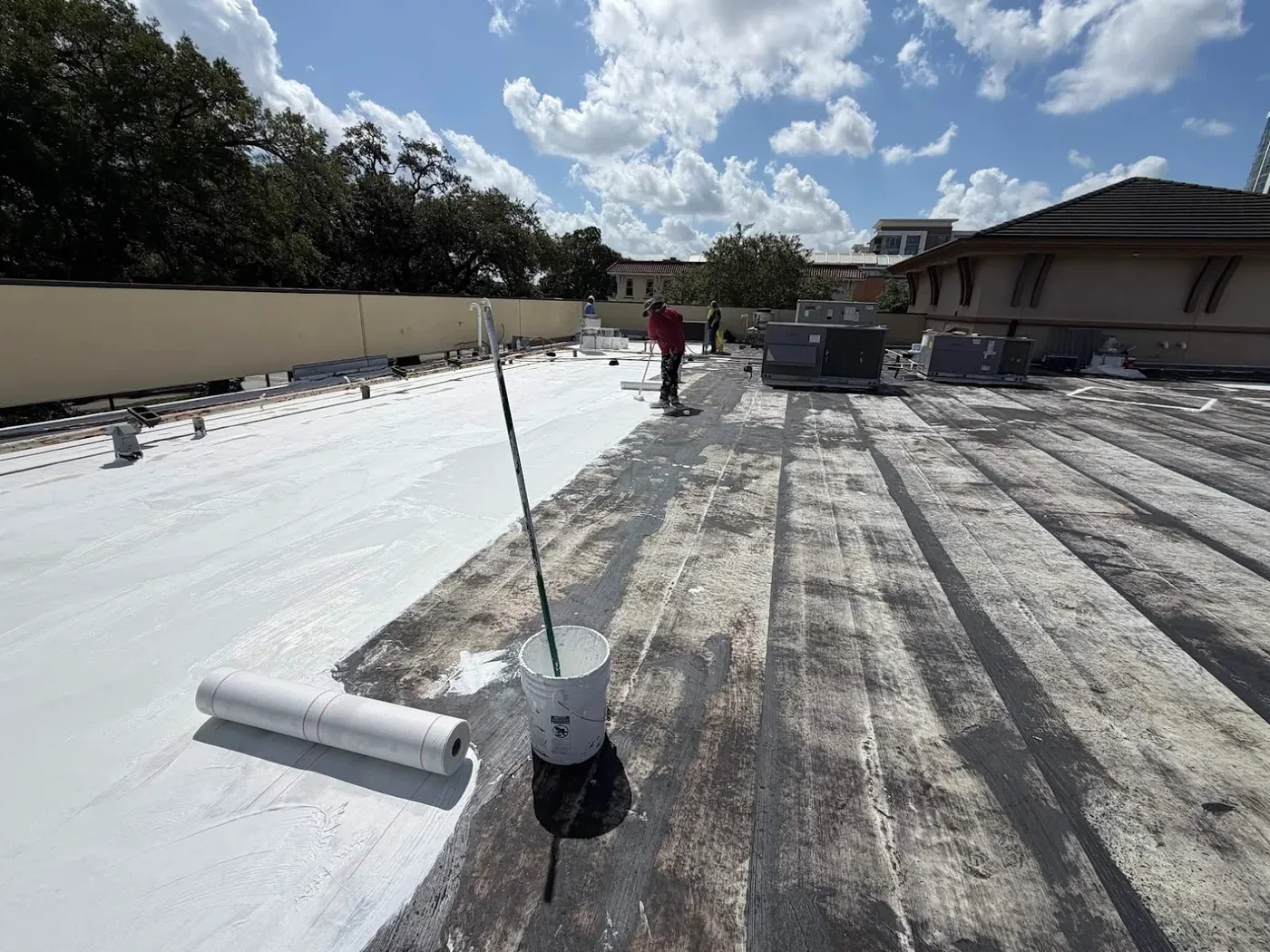
Choices follow the building. A depot with wide decks and heavy equipment suits a fully adhered or mechanically attached single ply with a cover board for traffic. A masonry civic building with parapets suits a built-up or modified bitumen system matched to the existing flashing. A small park building may suit metal. Cool-roof surfaces reduce cooling load where air conditioning runs most of the year. Each option is priced and rated so a procurement officer can defend the choice. Coatings extend a sound roof, and roof coating restoration is priced next to a replacement for the same roof so the agency sees the gap in service life. The comparison also shows what a recover costs against a tear-off, which matters where debris disposal, noise or building closure carry their own costs.
Capital plans, grants and phasing
Agencies fund roofs from capital budgets, operating budgets and grants, and each source has rules. We separate maintenance, repair and replacement so the right dollars pay for the right work, and we phase replacements by condition and consequence. Roofs over public rooms and critical equipment come first.
For grant applications, the log supplies photographs, ratings and cost ranges. Roof capital planning turns the portfolio into a schedule across fiscal years. Because New York City snow averages 29.8 inches a year and January 23, 2016 put down 27.3 inches within a day, the plan includes winter checks on drains and overflow, with attention to buildings near St. George and New Springville.
Related Roofing Work
More roofing work that comes up alongside Public Agencies.
Commercial Roofing Questions
How do you help an agency with an emergency purchase?
We supply photographs, a written hazard description, a temporary-protection scope and a price, ready for the agency's emergency procurement path.
Can you write a scope to the agency's bid format?
Yes. We adapt to the format and work with procurement staff on quantities, unit prices and alternates.
What records do auditors ask for?
Dates, photographs, scope, cost and the name of the crew lead. The roof log carries all of them.
How do you handle security rules?
We submit crew lists early, follow badging and escort rules and plan deliveries with building staff.
What helps a grant application?
A condition rating, photographs, scan results and a cost range for each roof.