
Seam Failure Repair in Staten Island, NY
Seam repair for Staten Island commercial roofs: open welds, lifted laps, split tape and ponded seams on single-ply and modified bitumen. Request an inspection.
A hairline of dirt tracing a seam across a roof, straight as a ruled line and darker on one side, is how an inspector first sees a seam that has begun to open, because dirt and moisture collect in the gap long before water finds its way through. The field of the membrane may be sound for years afterward. The seam is the weakest line on the roof, and when it goes, it goes along its whole length.
Commercial Roofing Staten Island repairs open, lifted and split seams on commercial roofs across the island, and we mark every seam we probe on a roof plan so a facility director can see where the line is failing and how fast.
What a seam is
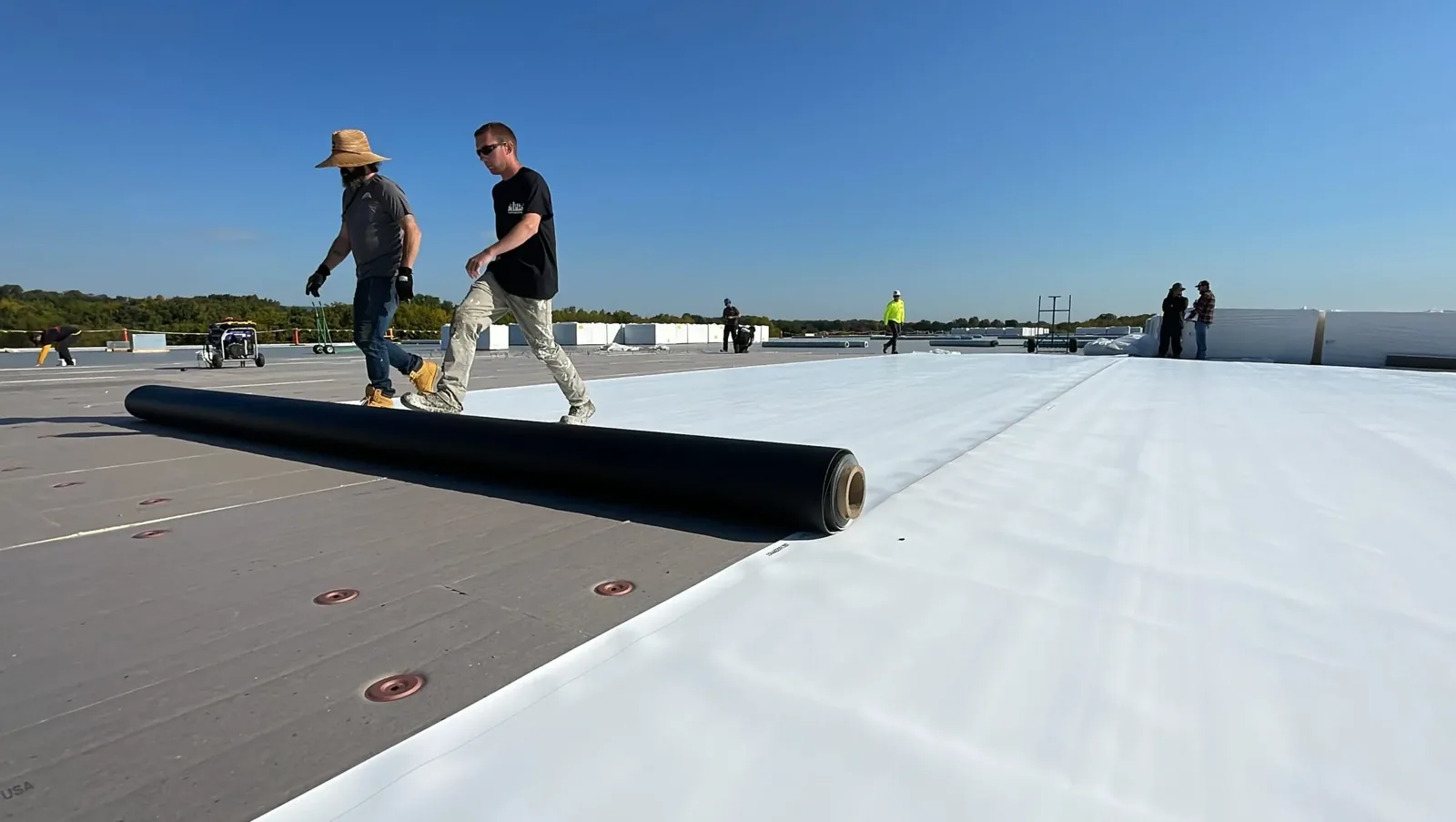
A seam is the joint between two pieces of roofing, and its job is to be as watertight as the sheet on either side. On TPO and PVC, seams are welded with hot air so the sheets fuse. On EPDM, they are joined with tape or adhesive. On modified bitumen, laps are heated or adhered, and on metal, seams are folded or snapped together. Each type fails differently, but the cause is almost always movement, contamination or age.
Movement comes from the roof itself. A membrane expands in the sun and contracts at night, the deck moves under load and the insulation shifts, and every seam sits on that moving surface. A weld made on a damp or dirty day starts with a flaw, and a flaw plus years of movement is a split.
Contamination is the quiet cause. Dust, oil, moisture or a film from a cleaning product on the mating surfaces keeps a weld from fusing, so the seam looks closed and peels under a probe a year later. Welders clean both faces before every weld, and a seam made without that step is the one that tests cold.
Where seams fail on the island
Seams fail at drains and low spots first, where water sits on them, and at intersections, where three sheets meet and the weld is hardest to make. They fail along fastener lines, where the sheet is pulled tight, and at transitions between old and new roofs. Any building that has grown by additions, as retail centers in New Springville and along Hylan Boulevard have, has transitions where a newer roof section meets an older one. Large West Shore roofs have the other seam problem, which is length. The Matrix Global Logistics Park began operating in Bloomfield in 2018 and the Teleport industrial park sits at Travis's eastern edge, and a big flat roof in that part of the island can have miles of seam. A small failure rate on that much seam is a leak every season.
Transitions deserve their own look. Where a roof meets a wall, a curb or an older section, the seam turns a corner, and corner seams carry the greatest stress. The T-joint, where three sheets meet, is the single hardest weld on a roof, which is why inspectors probe it twice.
How we probe a seam
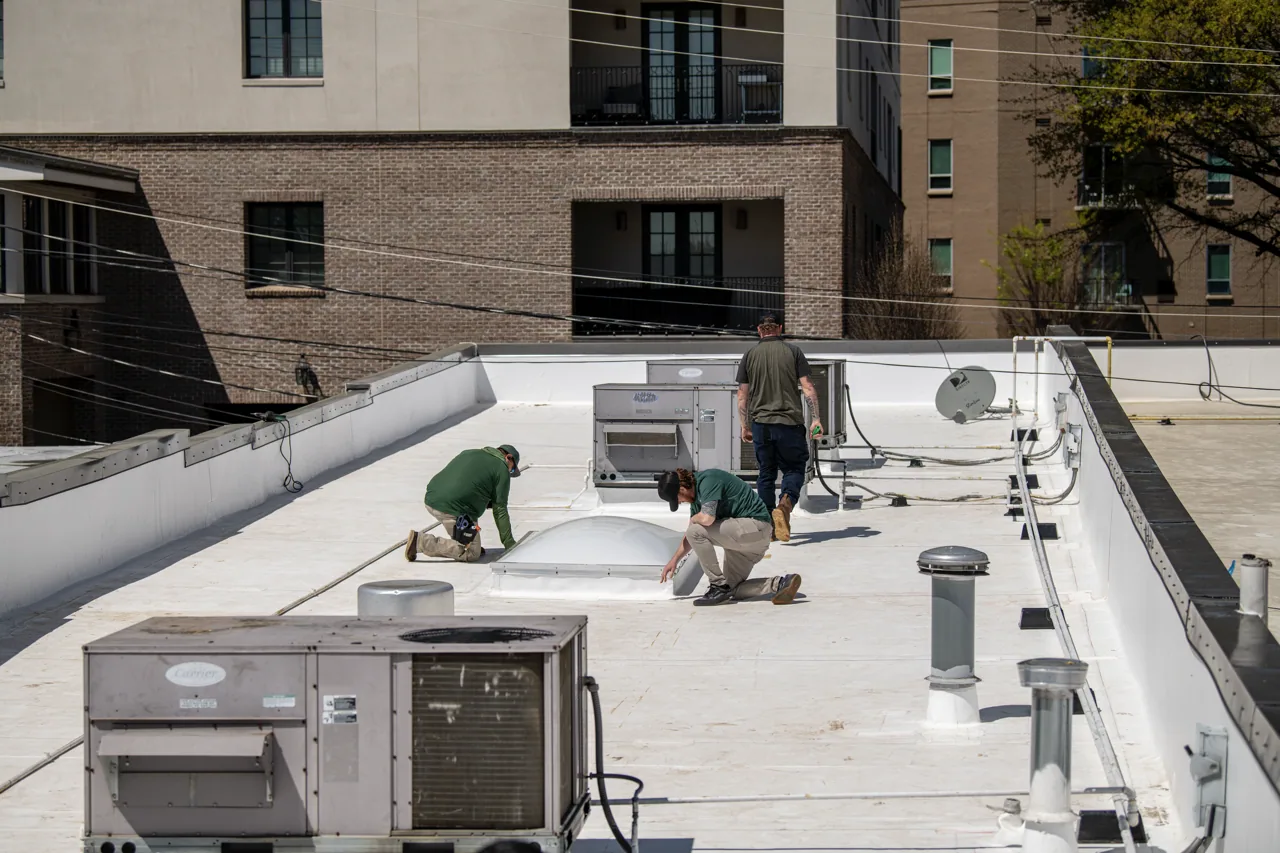
We probe seams with a flat tool, run it along the edge and mark any spot where it slides in. We look at the seam from a low angle, since a lifted edge casts a shadow. We note ponded seams, cold-welded seams that look closed but peel under a probe and seams crossing fastener lines.
- Open seams, where the probe slides under the edge.
- Lifted laps on modified bitumen, where granules at the edge are gone.
- Split tape on EPDM, with dirt in the gap.
- T-joints and intersections, which fail first.
Each probe result is marked on the roof plan with a number, so the inspection log shows seam by seam what is open, what is closed and what was repaired.
Seams that cross fastener lines get extra attention, since the sheet is pulled tight there and the plate can print through. Seam probes are done on a dry roof when possible, because water in a lifted seam hides the gap.
The repair in plain terms
A short open seam on a clean sheet is cleaned and re-welded or re-taped, then probed again. A long run of open seams on an aging sheet is a different conversation: patching it seam by seam is possible, and it also tells us the sheet is nearing the end. A seam that failed because it sat wet gets the drain or the slope fixed along with the repair, or the same seam opens again. These repairs sit inside commercial roof repair work.
If the seams are failing across the roof, a roof recover or a commercial roof replacement is the right recommendation, with the moisture scan and the core cuts deciding which one. For TPO, a cold weld is re-made after the old seam is cleaned and the edge cut back to sound sheet.
Cost drivers are plain: linear feet of seam, whether the sheet will still weld, the number of intersections and the cause behind the failure. Seam repair is priced by the foot with a minimum for the mobilization, and we show the owner the cost of the repair next to the cost of the next step up so the decision is made on numbers.
Storm and winter checks
Seams take the weather directly. A ponded seam under the rain of Ida's September 2021 flash flood emergency is a seam under test. The city's yearly snow total sits near 29.8 inches and hit 27.3 inches on the record day, and freeze and thaw move a seam every night in winter. Wind of the 80 mph Sandy brought in October 2012 lifts a seam that is already open. After any storm we walk the seams near edges and drains first, and we mark any that moved. A seam found open in the spring costs a repair, and a seam found open in the ceiling costs more.
Repairs are made in dry, moderate weather, since a seam welded in rain or deep cold is the seam that fails next year. We schedule repairs for the windows the weather gives, and temporary tape or mastic covers a seam that cannot wait.
What goes in the log
Every seam visit enters the log with the roof plan, the numbered probe results, photographs of each repair and the date. The log also notes any membrane puncture or flashing failure found next to a seam, since the three often travel together.
For a building in New Springville or on the West Shore, the roof plan and the leak history start the work. When a repair grows into a larger scope, the filings are confirmed with the city's Department of Buildings, which issues the 2022 NYC Construction Codes.
A preventive maintenance visit each spring probes the seams near drains and edges, and the log shows the trend from one year to the next.
Related Roofing Work
More roofing work that comes up alongside Seam Failure Repair.
Commercial Roofing Questions
Why do seams open?
Movement, contamination and age. A weld made on a dirty or damp day starts weak, and years of expansion and contraction finish it. The cause shapes the repair.
Can an open seam be repaired without replacing the roof?
Yes, if the sheet is still sound. We clean the area, cut back to good material, re-weld or re-tape the seam and probe it again, and the repair goes in the inspection log.
What if many seams are failing?
That points to an aging sheet. A moisture scan and cores decide between a recover and a replacement.
Why does the same seam keep opening?
Usually because water sits on it. Fixing the drain or slope is part of the repair.
How soon should an open seam be fixed?
Before the next storm. Water gets into the insulation through even a short opening, and wet insulation is the costly part of the repair.