
Membrane Puncture Repair in Staten Island, NY
Puncture and foot-traffic damage repair for Staten Island commercial roofs: tool drops, cable pulls, equipment feet and worn paths. Request an inspection.
A fresh hole the width of a pencil with silver filings scattered around it and a coil of new cable running past is what an inspector finds the week after a telecom contractor has been on a roof, and it is the cleanest kind of puncture to repair because the cause is still lying there. Most punctures are quieter. A dropped fastener, a ladder foot, a pallet corner and a technician's boot heel on a worn path all take a little of the sheet each time.
Commercial Roofing Staten Island repairs punctures and traffic damage on commercial roofs across the island, and we record the location and cause of each so a facility director can stop the next one before it happens.
How roofs get punctured
Membranes are thin compared with the loads that cross them. A single-ply sheet is a fraction of an inch thick, and a modified bitumen cap is not much more. Punctures come from five sources: tools and fasteners dropped by trades, equipment feet and ladders set without pads, foot traffic along unprotected paths, debris blown onto the roof and damage from the inside, such as a fastener that backs out of the deck and pushes up against the sheet.
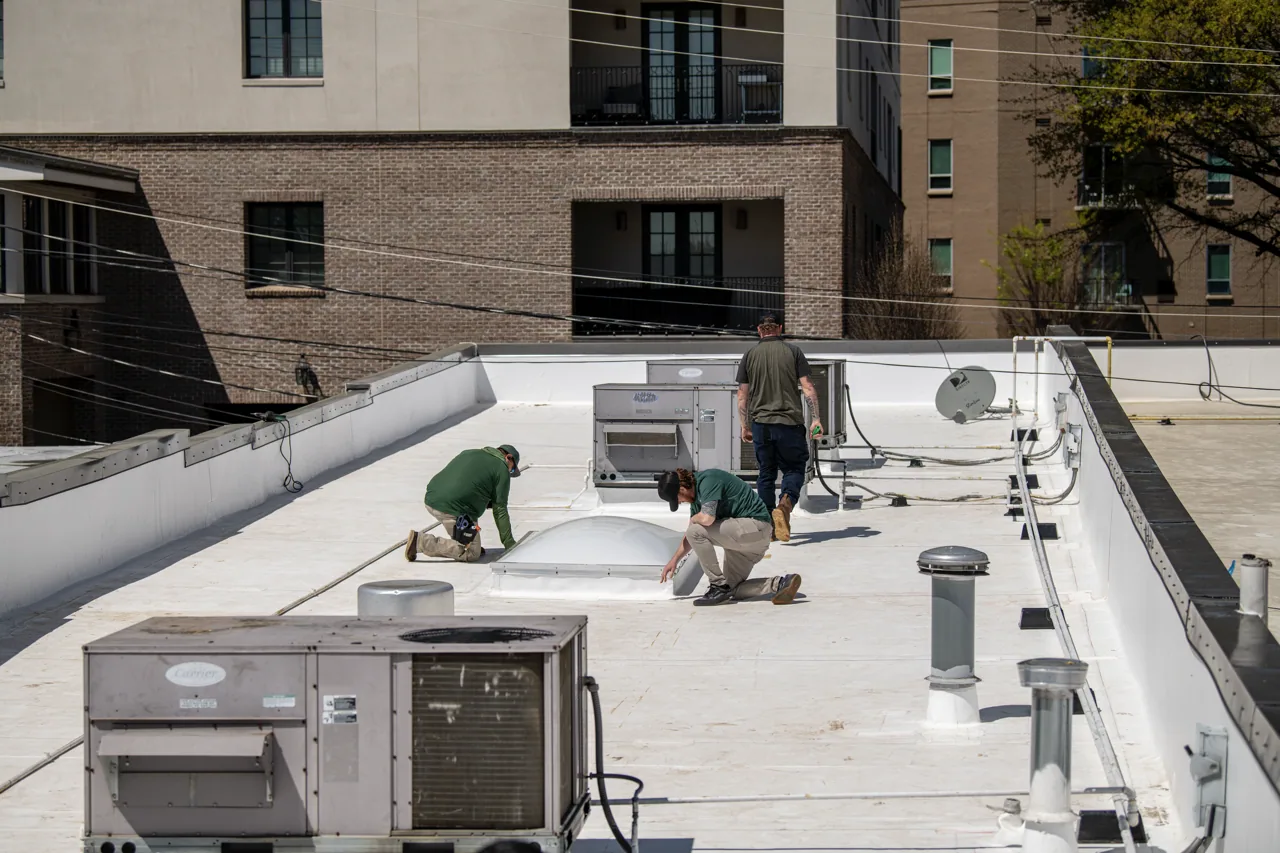
Roofs with the most equipment take the most abuse. Mechanical, telecom, solar and security contractors all use the roof, and each leaves a little of itself behind. The sheet remembers every visit, and an inspector reading a roof can often tell which trade was there by the pattern of damage.
Heat and cold change how punctures behave. A sheet is softer and more easily cut on a hot afternoon, and stiffer and more brittle in a hard freeze, so the same boot heel does more damage in July than in January and a dropped tool cracks a cold sheet instead of denting it. Scheduling roof access for mild days, where the work allows, saves membrane.
Where punctures show up on the island
Telecom and retail roofs are crossed by service technicians more often than most, and walk-pad wear is the first sign of it. Travis, at its eastern edge, has the Teleport industrial park, which is home mostly to Internet and telecommunications companies, and New Springville has the island's largest retail center.
Along Richmond Avenue and Hylan Boulevard, rooftop units are serviced on a schedule, and the path from the roof hatch to each unit becomes a worn line in the membrane within a few years. An open-air lifestyle center such as Charleston's Bricktown Centre is a retail property of the kind where a roof can carry equipment for more than one tenant. The roof shows the traffic even when the leak has not yet arrived.
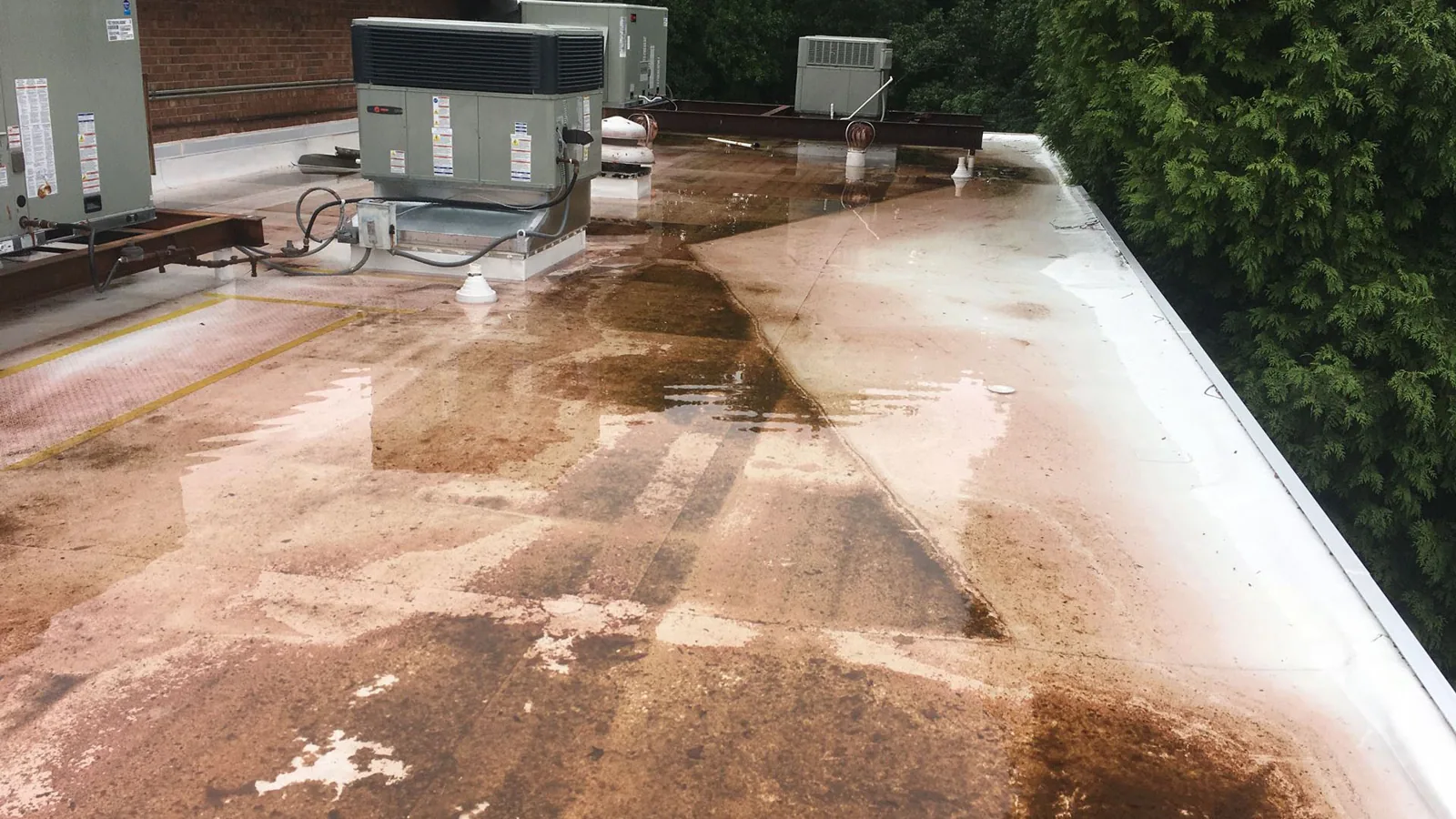
Inside the building, the clue is often a single drip that appears only after heavy rain. A small puncture lets in a little water at a time, and it takes a storm like Ida to push enough through to show. A ponding water area is a common place for this, because a puncture under standing water leaks all the time.
What the inspector looks for
We walk the service paths first, hatch to unit and unit to unit, looking at the walk pads and the sheet beside them. We check every spot where equipment sits, every ladder landing and every place a cable crosses the roof. We press suspicious spots, look for fastener pops and photograph each puncture with a coin for scale.
- Walk-pad wear and bare sheet along service paths.
- Equipment feet, ladder landings and cable crossings.
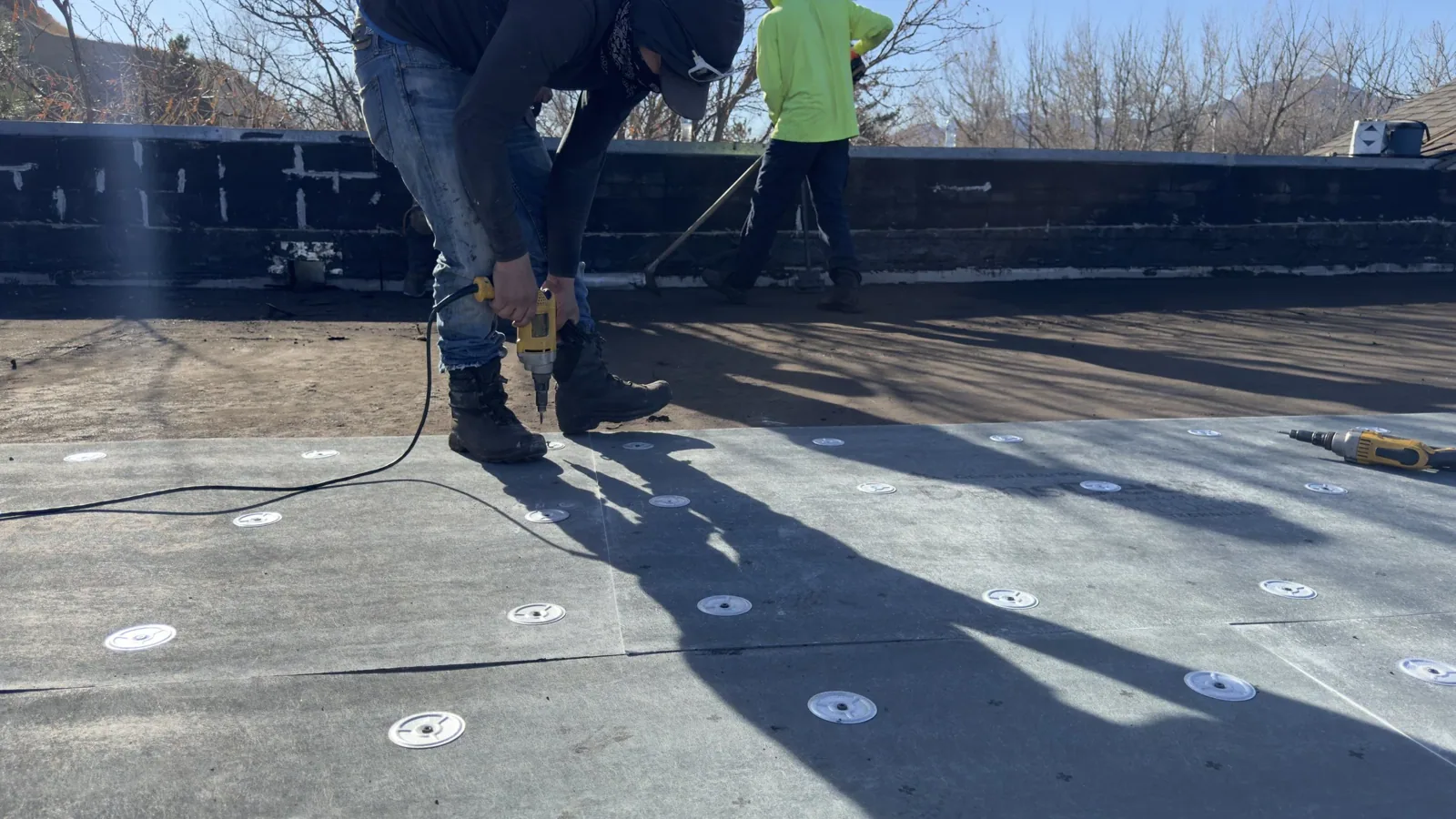
- Fastener pops, where a screw has backed out and pressed up under the sheet.
- Debris, since sharp items blown onto the roof can cut under foot traffic.
A moisture scan around each puncture finds whether water has already reached the insulation, and a puncture that has sat open through rain gets a core cut beside it.
The repair in plain terms
The repair depends on the sheet. On TPO or PVC, we clean the area, cut the damage to a clean shape and weld a round-cornered patch over it. On EPDM, we use a cured patch with seam tape or adhesive. On modified bitumen, we heat or adhere a new piece of cap sheet over the cut. On metal, a punctured panel is patched or replaced. In every case the patch laps well beyond the damage and its corners are rounded so they do not lift.
If the insulation under the puncture is wet, it is cut out and replaced first. A cluster of punctures in one bay can mean the sheet there has aged, and the answer moves toward commercial roof repair of the whole bay, or a roof recover over a dry roof. Punctures near a curb may point to a rooftop equipment support that needs a pad.
Cost drivers are plain: the number of punctures, the sheet type, whether insulation has to be replaced and how much of the roof needs pads. A single patch is among the cheapest repairs on a roof, which is why waiting is the expensive choice, and a set of walk pads along the service routes costs less than one wet ceiling.
Storm and winter checks
Storms add debris. Wind like Sandy's 80 mph gusts of October 2012 throws loose material across a roof, so a post-storm walk includes a sweep for sharp items. Hail and ice can also bruise a sheet, and New York City's average snowfall of about 29.8 inches a year puts shovels and ice tools on roofs that rarely see them. Snow removal on a membrane is done with plastic shovels and a plan.
Ida in September 2021 was the reminder about water. A puncture that sat open during that rain let in far more than one that was patched the week before, which is why a quick temporary patch is better than waiting for the full repair.
What goes in the log
Every puncture goes in the log with a number, a photograph, a cause if known and the date of the repair. Over time, the pattern shows which paths need pads and which trade needs a reminder. A seam failure found beside a puncture is noted in the same line.
A building in Travis or elsewhere on the West Shore starts with the roof plan and the list of contractors who use the roof, and the answer includes walk-pad routes and a sign-in rule. Filings for larger work are confirmed with the Department of Buildings, the office behind the 2022 NYC Construction Codes.
A short preventive maintenance visit replaces worn pads, repairs small cuts and checks the service paths, and it is the cheapest protection a membrane gets.
Related Roofing Work
More roofing work that comes up alongside Membrane Puncture Repair.
Commercial Roofing Questions
How can I tell a puncture from a seam leak?
A puncture is a hole or cut in the sheet, often with a clear cause nearby. A seam leak follows a line. We probe both and mark them separately.
Can a temporary patch hold until the full repair?
For days or a few weeks, yes. It keeps water out of the insulation, which is the costly part.
How do I stop trades from damaging the roof?
Lay walk pads along every service path, require pads under equipment feet and ladders and ask each trade to sign in. We supply a map of the routes.
Does a puncture void the warranty?
It can, if the damage came from other trades or foot traffic and the repair was not made to the maker's terms. We read the terms first.
Can punctures be found without walking the whole roof?
A drone survey finds many, and an infrared scan finds the wet ones. A walk with probes confirms them.