
Roof Warranty Management in Staten Island, NY
Keep roof warranties valid on Staten Island commercial roofs: maintenance duties, repair rules, transfers, exclusions and records that survive a claim.
A warranty binder with a page-fourteen clause underlined, requiring an inspection each year and written notice before any outside contractor touches the roof, is what an inspector finds on a good day, and on most days it is a folder nobody can locate. A warranty is a contract with duties on both sides. The owner who forgets the duties can lose a roof's coverage without a single leak to show for it.
Commercial Roofing Staten Island helps owners on the island read, track and keep roof warranties valid, from the first day of a new roof through every repair, rooftop addition and sale, with each duty put on a calendar in the owner's name.
What a roof warranty is
A commercial roof warranty is a written promise from the manufacturer, and sometimes the installer, to repair or replace defective materials or workmanship for a stated term. It is not insurance. It does not cover storms, punctures from other trades, ponding beyond a limit or damage the maintenance record could have prevented. What it does cover depends entirely on the wording, which is why the wording matters more than the length of the term.
Three kinds are common. A material warranty covers the product. A workmanship warranty covers the installation. A system warranty covers both and usually carries the strictest conditions. Each has exclusions, and each has procedures for making a claim.
The term itself is a poor guide. A twenty-year promise with a ponding exclusion, a wind limit below the island's storms and a requirement that only the maker's applicator may repair it is worth less than a shorter one with plain terms. We read warranties the way an adjuster reads a policy, from the exclusions inward, and tell the owner what the coverage is worth in practice.
Where warranties get lost
Warranties are lost in ordinary ways. A rooftop unit is added by a mechanical contractor who cuts the membrane without the maker's approval. A patch is made with the wrong material. An annual inspection is skipped. Ponding is allowed to continue past the stated limit. A building is sold and the transfer paperwork is never filed. None of those is a leak, and each can end the coverage.
The island has plenty of roofs where this matters. Retail centers have lined Hylan Boulevard since Hylan Plaza opened in 1966, the Staten Island Mall saw an expansion between 2016 and 2019, and the Matrix Global Logistics Park came to Bloomfield in 2018. Any property with additions, tenants and rooftop equipment accumulates warranty risk, and the terms differ on every roof.
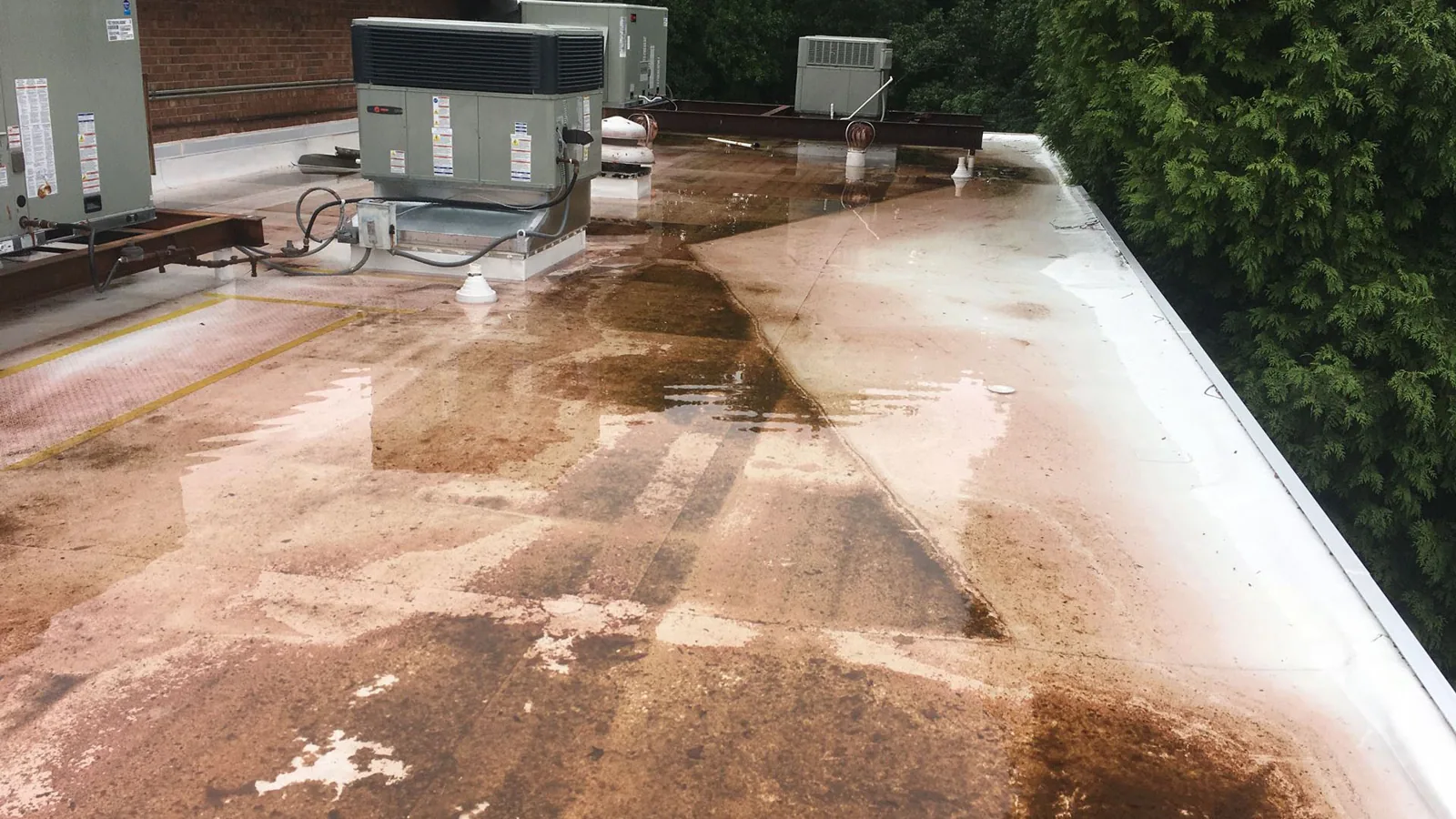
Ponding is the most common quiet exclusion. Many warranties void coverage over any area that holds water for more than a stated time after rain, and a roof with a clogged drain can lose coverage without a leak. A ponding water problem is therefore a paperwork problem as well as a roofing one, and drains are on the calendar for that reason.
What we read in the papers
We start with the warranty itself. We read the term, the coverage, the exclusions, the maintenance duties, the notice rules, the limits on ponding and wind, the procedure for repairs by others and the rules for transfer. We match the papers to the roof we find, since the system on the roof sometimes differs from the one on the paper.
- Term, type and who issued it.
- Maintenance duties and inspection requirements.
- Rules for repairs, additions and penetrations.
- Exclusions, including ponding, wind and traffic damage.
We then put the duties on a calendar, with dates, so the owner is told before a deadline passes instead of after.
We also check who installed the roof and whether the installer's workmanship terms still run, since a company that has closed or changed hands may leave the owner with only the maker's material coverage. The papers show it, and the roof sometimes does not.
Keeping coverage alive
Four habits keep a warranty alive. Inspect on the schedule the terms require and keep the report. Use only approved methods and materials for repairs, and give written notice when the terms ask for it. Control access, so every trade that goes on the roof signs in and uses walk pads. And keep records, so a claim has paperwork behind it.
When a repair is needed, the first question is whether the warranty requires the maker or its approved applicator to do it. If so, we coordinate, and if not, we repair to the maker's details and document it. Our commercial roof repair work follows the maker's published details, and our preventive maintenance visits supply the inspection records many warranties require.
Cost drivers are plain: the number of roofs, how much of the file is missing and whether the maker requires an inspection by its own representative. A file rebuild costs a few hours per roof, and a missed deadline can cost the coverage. We price the file work apart from any repair.
Weather and the fine print
Wind and water test the exclusions. Sandy's 80 mph gusts of October 2012 and the rain behind Ida's flash flood emergency in September 2021 are the storms owners measure claims against. Most warranties exclude damage from named storms or winds above a stated speed, which means a storm loss is usually an insurance matter and not a warranty one, and the roof record has to show which is.
Winter has its own exclusions. Snow in New York City adds up to roughly 29.8 inches a winter and damage from ice, snow removal tools or structural overload is commonly excluded. A fall inspection and a thaw-season walk, entered in the log, keep the owner on the right side of the clauses.
After any storm, the first call to the maker is a notice, and the second is the insurer. Keeping the two separate in the paperwork is how an owner collects from the right party, and the log records the dates of each.
What goes in the log
The warranty file holds the papers, the roof system record, every inspection report, every repair with its materials and method, the sign-in sheets for roof access and the notices sent to the maker. If a claim is made, the file is the claim. A repair that changes the roof's assembly may need filings with the Department of Buildings, where the 2022 NYC Construction Codes are issued, and the maker's approval too. For a building in New Dorp or elsewhere on the island, the warranty papers and the roof plan are where the work starts. Warranty tracking sits naturally beside roof asset management and due diligence roof surveys, where transfer terms matter at sale.
Before any sale, the file is brought up to date, the transfer rules are read and the filing deadline goes on the calendar. A buyer who sees a complete warranty file sees a roof that has been looked after.
Related Roofing Work
More roofing work that comes up alongside Roof Warranty Management.

Commercial Roofing Questions
Is a roof warranty the same as insurance?
No. A warranty covers defects in materials or workmanship under stated terms. Storm and impact losses are usually insurance matters.
Can another contractor repair my roof without voiding the warranty?
Sometimes. Many warranties require approved methods or written notice. We read the terms first and follow them.
Do I need an annual inspection?
Many warranties require one and some require it from an approved party. We check what yours says.
Does the warranty transfer when I sell?
Some do, with conditions and fees. The terms and the paperwork decide, and the filing has to be made on time.
What if I cannot find the papers?
We can often identify the system from the roof and the records, and the maker may have the file. We help request it.